Best Three.js Websites: 12 Live Examples, Measured and Taken Apart
Quick answer. The best Three.js websites right now include GitHub, Shopify Editions, Cartier, Igloo Inc, Lando Norris and Bruno Simon's portfolio. We opened twelve in Chrome on 10 November 2026 and read the version each runs: r148 (December 2022) to r187 (October 2026). One renders with WebGPU. Page weight ran from 3.2 MB to 70 MB.
Which one are you? The list is the same. The next step is not.
- Building this for your own product. Skip to what it costs, then send us the product and the deadline on WhatsApp. You get a fixed number back within 24 hours, not a range. Prefer email? Get your price here.
- Agency or freelancer with a client who wants a Three.js site. We build the scroll part white-label, fixed price, on your timeline. You keep the client and the credit. Send the brief and the number comes back within 24 hours.
- Collecting references. Good. Bookmark it. The side-by-side table and the one-line version check are the parts worth saving.
Most lists of the best Three.js websites are screenshots and adjectives. Fine for mood. Useless if you are about to pay for one, because they never say what the site weighs, whether it works on a phone, or how old its code is.
So we measured. On 10 November 2026 we loaded 52 sites that turn up on best-of lists and award galleries, read the Three.js version each one exposes, and took the best 12 apart: page weight before and after scrolling, draw calls per frame, renderer, framework, and a separate pass at phone size. Every number below comes from those captures.
Free, and from a human
What would a Three.js site for your brand cost?
Send me your site or your product page. I read it myself and reply within 24 hours with a fixed price, what I'd build first, and whether it's worth doing at all. If a scroll story won't move your numbers, I'll say so and you keep the plan.
Got it. A confirmation is on its way to your inbox, and your price follows within 24 hours, from me. Rather talk it through? Book 15 minutes →
No call needed. Builds start at $3,000 and usually take 2 to 4 weeks. Streets of Punk and Nugget Nation are two of ours.
The 12 Three.js websites at a glance
| Site | Category | Three.js | Released | On load | After scrolling | Draw calls per frame | Phone pass |
|---|---|---|---|---|---|---|---|
| GitHub | Developer platform | r148 | Dec 2022 | 3.2 MB | 3.4 MB over 8.5 screens | 21 | 3D drawn, 3.2 MB |
| Shopify Editions Spring '26 | Product launch | r183 | Feb 2026 | 4.8 MB | 24.4 MB over 43.3 screens | 77 | No 3D in 9 s, 2.0 MB |
| Cartier Watches and Wonders | Luxury | r183 | Feb 2026 | 70.0 MB | 70.0 MB, single screen | 77 | 3D drawn, 64.0 MB |
| Oryzo | Product reveal | r178, modified | Jun 2025 | 16.4 MB | 16.4 MB over 63 screens | 38 | 3D drawn, 10.3 MB |
| Organimo | DTC store | r151 | Mar 2023 | 24.4 MB | 24.5 MB, single screen | 15 | 3D drawn, 24.4 MB |
| Lando Norris | Athlete | r174 | Feb 2025 | 5.5 MB | 7.8 MB over 15.1 screens | 23 | 3D drawn, 7.3 MB |
| Explore Primland | Resort real estate | r179 | Aug 2025 | 28.2 MB | 28.2 MB, single screen | 41 | 3D drawn, 13.0 MB |
| NASA Eyes on the Solar System | Science | r185 | Jun 2026 | 4.6 MB | 4.7 MB, single screen | 87 | 3D drawn, 4.5 MB |
| Igloo Inc | Web3 brand | r165 | May 2024 | 15.3 MB | 15.3 MB, single screen | 48 | 3D drawn, 15.3 MB |
| Messenger | Browser game | r180 | Sep 2025 | 5.9 MB | 5.9 MB, single screen | 25 | 3D drawn, 3.6 MB |
| Lusion | Studio | r158 | Oct 2023 | 11.1 MB | 11.1 MB, single screen | 85 | 3D drawn, 9.0 MB |
| Bruno Simon | Portfolio | r187, WebGPU | Oct 2026 | 7.5 MB | 7.5 MB, single screen | about 252 (WebGPU) | 3D drawn, 7.5 MB |
12 Three.js website examples, taken apart
Ordered from brands you know to the studios and makers behind the craft. Every number comes from the live page in desktop Chrome at 1440 by 900. We record what loaded in the first eight seconds, then the total after scrolling to the bottom. Eight of the twelve are a single screen that turns your scroll wheel into camera movement; for those we sent 40 wheel steps instead, and none loaded more than 0.1 MB extra. Draw calls are averaged over three seconds. Each one is an instruction to the graphics card, so it is a rough gauge of how hard the scene works. The phone pass is the same page at 390 by 844 with an iPhone browser identity.
Unless an entry says otherwise, an agency would quote $20,000 to $50,000+ for a brand site like these. Our Flagship builds start at $3,000, usually 2 to 4 weeks, with real-time 3D scoped per project.
1. GitHub, developer platform
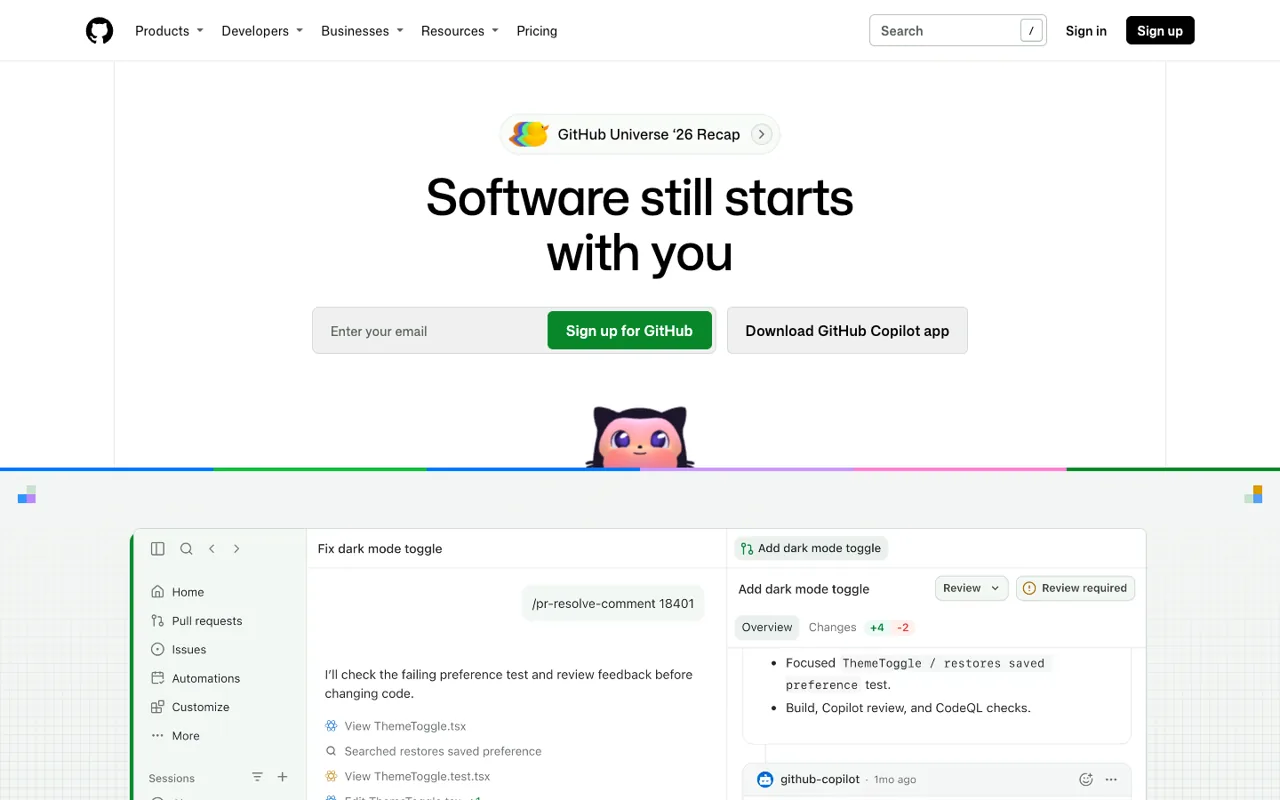
Three.js r148, released December 2022 · Renderer: WebGL 2 · 3.2 MB in the first 8 seconds, 3.4 MB over a full scroll of 8.5 screens · 21 draw calls per frame · Framework: React · Phone pass: 3D drawn, 3.2 MB · Agency band for a build like this: $5,000 to $15,000
GitHub uses Three.js the way most companies should: as a garnish. The homepage is a headline, an email box and a product screenshot. Peeking over the screenshot is Mona, GitHub's octocat, rendered live from a 0.22 MB model into a canvas 175 pixels square.
The restraint shows in the numbers: 3.2 MB on load, 3.4 MB after 8.5 screens, 21 draw calls per frame. Most of that weight is JavaScript, not 3D. It also runs the oldest Three.js in this list, r148 from December 2022. Nobody upgrades a mascot that works.
Steal this: One small live object near the headline gives a page life without a 3D budget. Keep it under a megabyte, model included.
2. Shopify Editions Spring '26, product launch
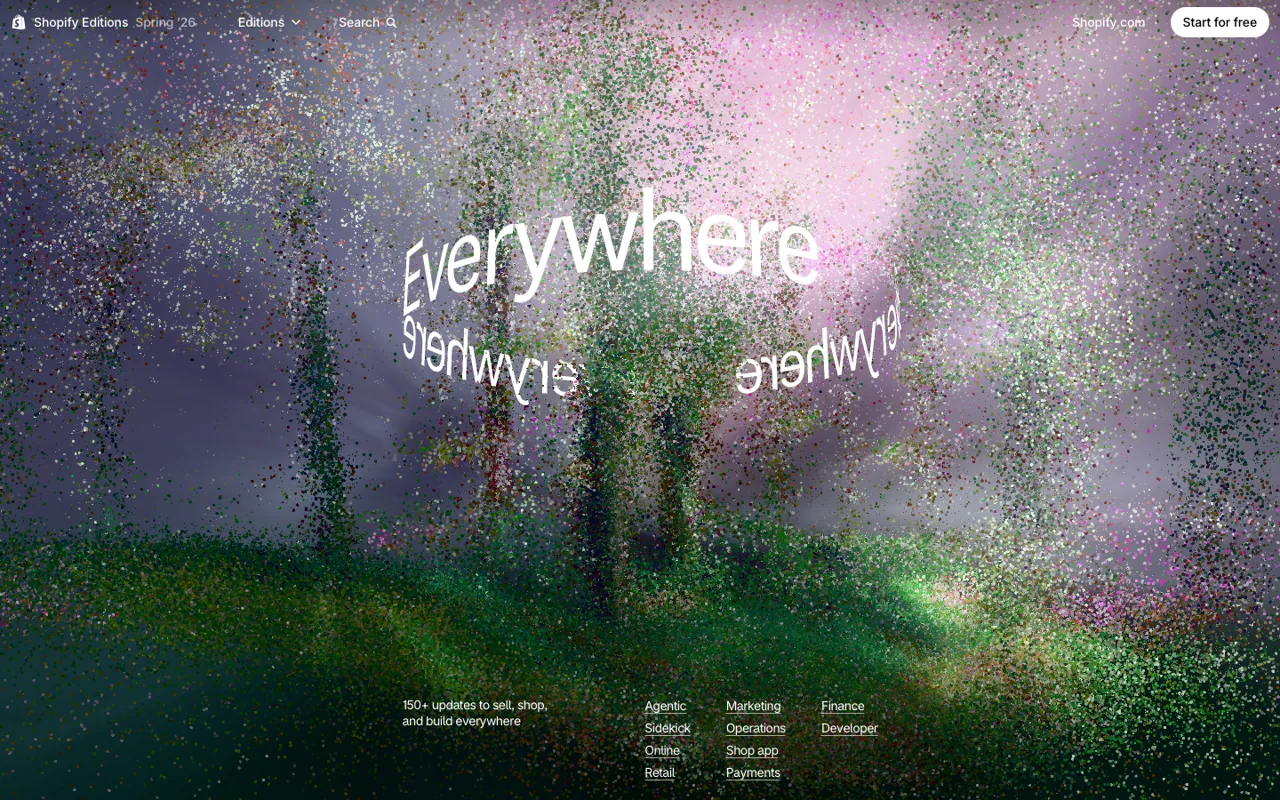
Three.js r183, released February 2026 · Renderer: WebGL 2 · 4.8 MB in the first 8 seconds, 24.4 MB over a full scroll of 43.3 screens · 77 draw calls per frame · Framework: React, Lenis smooth scroll · Phone pass: no 3D drawn in 9 seconds, 2.0 MB
Shopify gives each batch of product updates its own launch site, called Editions. Spring '26 announces 150-plus updates and opens on the word “Everywhere” bending through a forest built from coloured particles. Then it keeps going for 43.3 screens, the longest page here, with 13 videos and real-time scenes between them.
It is the best-managed weight in the list. 4.8 MB arrives in the first eight seconds and the rest loads as you reach it, 24.4 MB by the bottom. The textures ship as KTX2, a format that stays compressed on the graphics card, and judging by the file names even the little video loops inside the scene are KTX2 files of 14 to 50 frames each.
On the phone pass it created a 3D context and drew nothing in nine seconds, loading 2.0 MB. Either phones get a lighter cut first or the scene waits for a scroll. Both are the right call.
Steal this: Load each chapter's 3D when the visitor reaches it. The first screen should cost what the first screen shows, not what the whole page shows.
3. Cartier Watches and Wonders, luxury

Three.js r183, released February 2026 · Renderer: WebGL 2 · 70.0 MB in the first 8 seconds, nothing more after 40 wheel steps (single-screen page) · 77 draw calls per frame · Framework: Nuxt (Vue) · Phone pass: 3D drawn, 64.0 MB · Agency band for a build like this: $60,000 to $150,000+
Cartier's Watches and Wonders site is one continuous 3D scene. It opens on snow falling in a pale room with a tall lattice door and the line “Watchmaker of shapes, master of crafts.” The page itself is a single screen; the scene does all the moving.
It is the heaviest page in this list by a factor of two and a half: 70.0 MB in the first eight seconds. 36.2 MB of that is 3D models, four of them over 4.8 MB each, named for the scene and for Cartier watches: mainScene, mainScene_characters, crash_desktop, santos_desktop. Another 16 MB is images, including a 7.8 MB animated GIF in the menu. On our 1x test screen the canvas is drawn at 2160 by 1350, more than twice the pixels the window needs.
The file names end in _desktop, which suggests phone versions exist. The phone pass still moved 64.0 MB. It drew the scene. On a mid-range phone on mobile data, most people will not wait to see it.
Steal this: Copy the single-scene structure, not the payload. Give every model a size budget and a phone version, and swap any GIF for a video file a fraction of the size.
4. Oryzo, product reveal
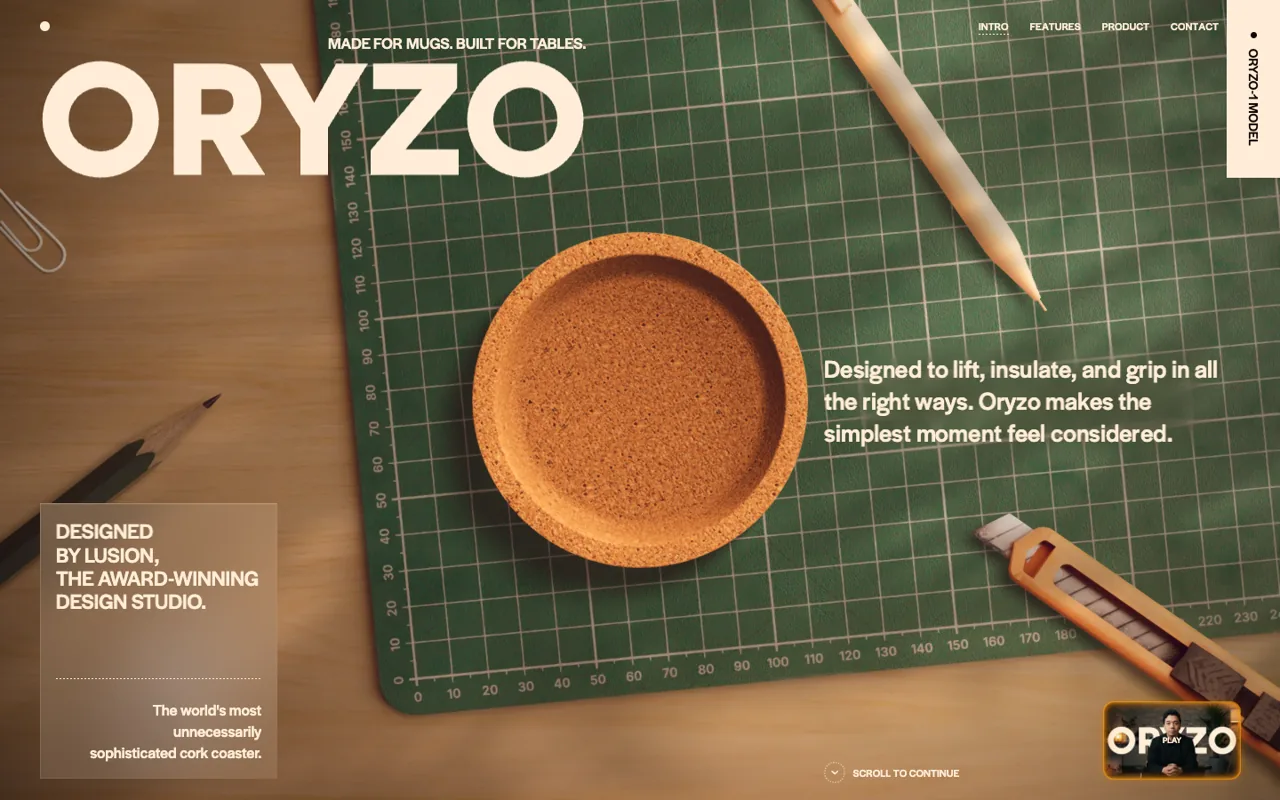
Three.js r178, a copy modified by Lusion, released June 2025 · Renderer: WebGL 2 · 16.4 MB in the first 8 seconds, 16.4 MB over a full scroll of 63 screens · 38 draw calls per frame · No front-end framework detected · Phone pass: 3D drawn, 10.3 MB
Oryzo is a cork coaster presented like a flagship phone. The page calls it “the world's most unnecessarily sophisticated cork coaster” and then spends 63 screens of scroll on it, starting with the coaster on a cutting mat between a pencil and a craft knife. Lusion, number 11 on this list, designed it and says so on the first screen.
Two details make it worth studying. Its copy of Three.js reports itself as “178, modified by Lusion,” so the studio works from its own patched version. And it loads a 3.1 MB Gaussian splat file named props. Splats capture a real object from photos as a dense cloud of soft coloured points instead of modelling it by hand, and they are the newest technique in this list.
All 16.4 MB arrives up front, and 63 screens of scroll add nothing. The phone pass loaded 10.3 MB.
Steal this: If the product is simple, make the presentation absurdly serious; the joke does the marketing. And price out a splat before paying for a hand-built model of a real object.
5. Organimo, DTC store

Three.js r151, released March 2023 · Renderer: WebGL 2 · 24.4 MB in the first 8 seconds, 0.1 MB more after 40 wheel steps (single-screen page) · 15 draw calls per frame · No front-end framework detected · Phone pass: 3D drawn, 24.4 MB
Organimo sells sea moss capsules, and its homepage puts the jar on a rock floating in space under “Limitless begins here.” It runs on WordPress, with the Three.js scene shipped inside the theme. The stack does not decide whether a brand can have 3D.
It draws the least of anything here, 15 draw calls per frame, and loads one of the most: 24.4 MB. 13.8 MB of that is HDR environment maps, the panoramic images that light a 3D scene, with the space backdrop alone at 3.7 MB. A mountain model adds 1.75 MB. The phone pass loaded the same 24.4 MB.
A light scene in heavy files. The graphics card has an easy night; the visitor's data plan does not.
Steal this: Lighting maps are often the biggest files in a scene. Bake the lighting into the textures or ship the HDR at a quarter of the size; few people will notice on a phone.
6. Lando Norris, athlete

Three.js r174, released February 2025 · Renderer: WebGL 2 · 5.5 MB in the first 8 seconds, 7.8 MB over a full scroll of 15.1 screens · 23 draw calls per frame · No front-end framework detected, Lenis smooth scroll · Phone pass: 3D drawn, 7.3 MB
Lando Norris's site was built by the studio OFF+BRAND, which signs its name into the main script file. It opens on his face with a wireframe helmet drawn around it in real time. Behind it load the helmet textures, a race-track model and a lighting map.
For what it does, it is one of the lightest here: 5.5 MB on load, 7.8 MB after 15.1 screens. It runs 21 canvases, the most in the list, and no front-end framework: the site lives on Webflow, with the Three.js scene loaded in as custom code and Lenis smoothing the scroll. The phone pass drew it all at 7.3 MB, more than the desktop load, so phones get no lighter cut here.
Steal this: Put the person at the centre and build the 3D around them. A face holds attention longer than any object.
Have a product, or just a question about this? You don't have to book a call. Message us. Ishan replies within 24 hours.
Something went wrong. WhatsApp us instead?
Got it. If you gave an email, a confirmation is already on its way and Ishan replies within 24 hours.
7. Explore Primland, resort real estate

Three.js r179, released August 2025 · Renderer: WebGL 2 · 28.2 MB in the first 8 seconds, nothing more after 40 wheel steps (single-screen page) · 41 draw calls per frame · Framework: Nuxt (Vue), Lenis smooth scroll · Phone pass: 3D drawn, 13.0 MB
Primland is a resort in the Blue Ridge Mountains, and this is the site that sells homes on its estate. It is a map. Not an embed: a 3D model of the estate's terrain with clouds drifting over it, an “Explore the map” button, an Inquire link and the option to start with or without audio.
This is the real-estate case for Three.js. A home on an estate sells the land around it, and a map you can fly over shows that better than a gallery. The cost is in the textures: two KTX2 maps of the terrain, one for fall and one for summer, at 10.5 MB and 10.2 MB, both loaded up front. 28.2 MB in all.
The phone pass is the encouraging part: 13.0 MB, less than half. Phones get a much lighter load.
Steal this: If you sell land or a place, let people fly over it. Load the season they see first and fetch the other only when someone asks for it.
8. NASA Eyes on the Solar System, science
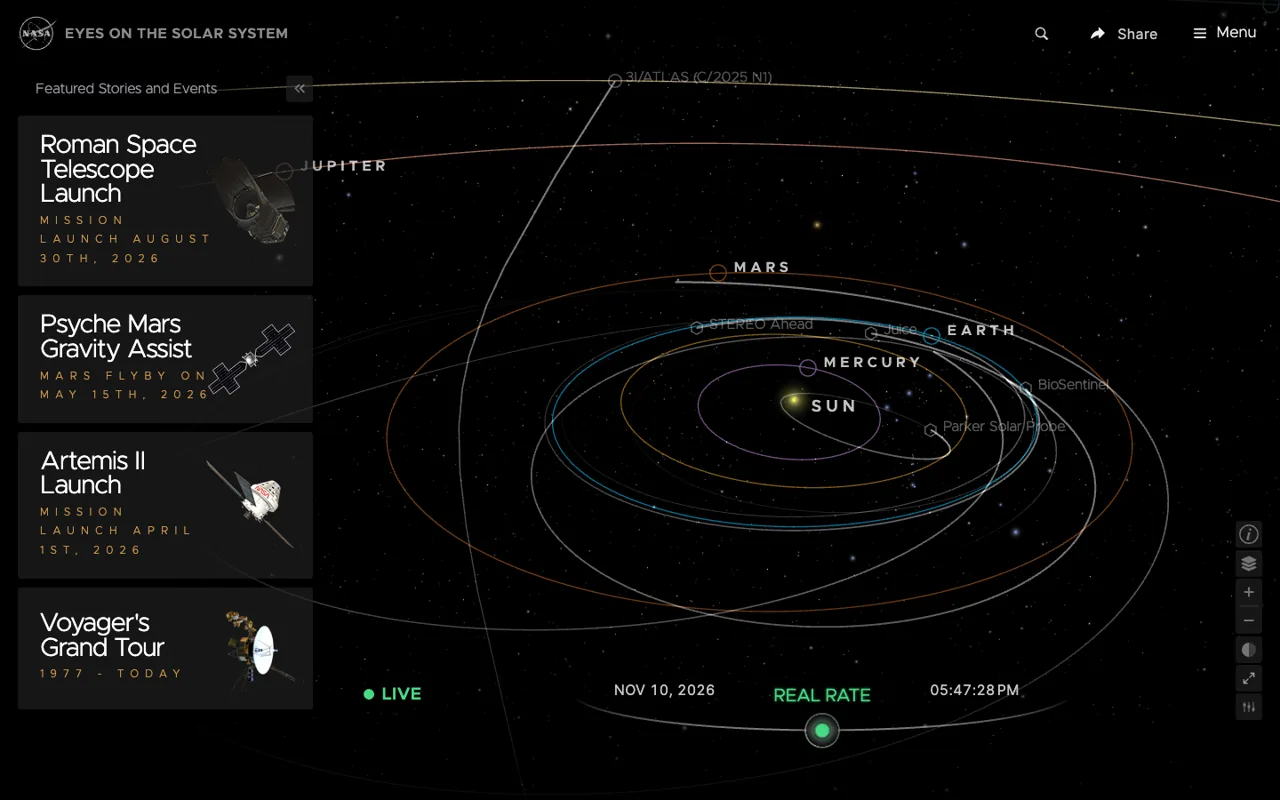
Three.js r185, released June 2026 · Renderer: WebGL 2 · 4.6 MB in the first 8 seconds, 0.1 MB more after 40 wheel steps (single-screen page) · 87 draw calls per frame · No front-end framework detected · Phone pass: 3D drawn, 4.5 MB
NASA's Eyes on the Solar System, from the Jet Propulsion Laboratory, is the most useful site in this list. It is a live model of the solar system, with planets and spacecraft where they are right now, the clock running at real rate along the bottom and featured missions down the side.
It is also one of the lightest: 4.6 MB on load and 4.5 MB on the phone pass. It works harder than any other WebGL site here, 87 draw calls per frame, because there is a lot of sky to draw.
And it runs Three.js r185 from June 2026. A government science tool is on newer code than every brand site in this list.
Steal this: 3D earns its weight when it lets people do something a flat page cannot. Build for the task first and the wow follows.
9. Igloo Inc, web3 brand

Three.js r165, released May 2024 · Renderer: WebGL 2 · 15.3 MB in the first 8 seconds, nothing more after 40 wheel steps (single-screen page) · 48 draw calls per frame · No front-end framework detected · Phone pass: 3D drawn, 15.3 MB · Agency band for a build like this: $60,000 to $150,000+
Igloo Inc is the parent company of Pudgy Penguins, and its site won Awwwards Site of the Year 2024. The studio Abeto built it: one igloo of ice blocks on a snowfield, monospaced type in the corners, and your scroll driving the camera.
15.3 MB, nearly all of it up front: 11 MB of KTX2 textures and a 2.95 MB music file. The sound is off until you turn it on, but the music downloads anyway. The phone pass loaded the same 15.3 MB.
We took it apart properly, with ten sites in the same format, in websites like Igloo Inc.
Steal this: If the music is optional, load it when someone presses play. That is 3 MB the other visitors never pay for.
10. Messenger, browser game
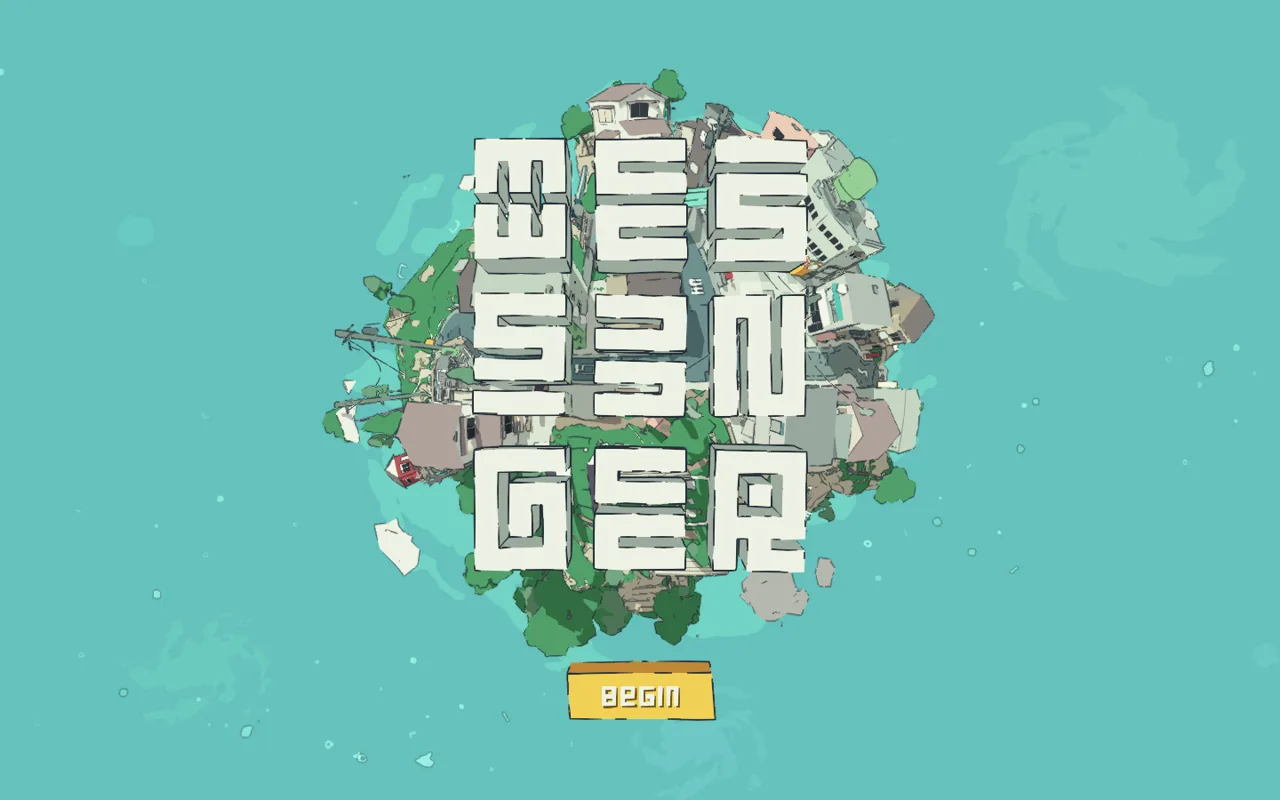
Three.js r180, released September 2025 · Renderer: WebGL 2 · 5.9 MB in the first 8 seconds, nothing more after 40 wheel steps (single-screen page) · 25 draw calls per frame · No front-end framework detected · Phone pass: 3D drawn, 3.6 MB · Agency band for a build like this: $60,000 to $150,000+
“It's a small planet, but someone's gotta make the deliveries.” That is Messenger's own description and the whole brief: a tiny planet in the browser, no install, from Abeto, the studio behind Igloo Inc.
It is a lesson in compression. 5.9 MB on load, and 3.7 MB of that is audio, mostly the soundtrack. The planet ships as Draco-compressed geometry and the textures go through the Basis transcoder, the two standard ways to shrink 3D files. Without the sound, the whole world is just over 2 MB. The phone pass loaded 3.6 MB.
Steal this: Run every model through Draco or Meshopt and every texture through KTX2 before launch. It is the cheapest speed win in 3D.
11. Lusion, studio

Three.js r158, released October 2023 · Renderer: WebGL 2 · 11.1 MB in the first 8 seconds, nothing more after 40 wheel steps (single-screen page) · 85 draw calls per frame · No front-end framework detected · Phone pass: 3D drawn, 9.0 MB
Lusion is the studio behind Oryzo, and its homepage is the pitch: a pile of blue, black and white 3D shapes in a dark panel under one sentence about what the studio does.
11.1 MB on load and 85 draw calls per frame, second only to NASA among the WebGL sites. Most of the weight is images, 6.3 MB, plus an EXR matcap: a small image that bakes a whole lighting setup into one texture.
One detail: Lusion's own site runs r158 from October 2023, while Oryzo runs a patched r178. At least one studio puts clients on newer code than its own site. The builder's house is always the last one finished.
Steal this: If the scene is shapes and materials, a matcap can stand in for a full lighting setup at a fraction of the rendering cost.
12. Bruno Simon, portfolio
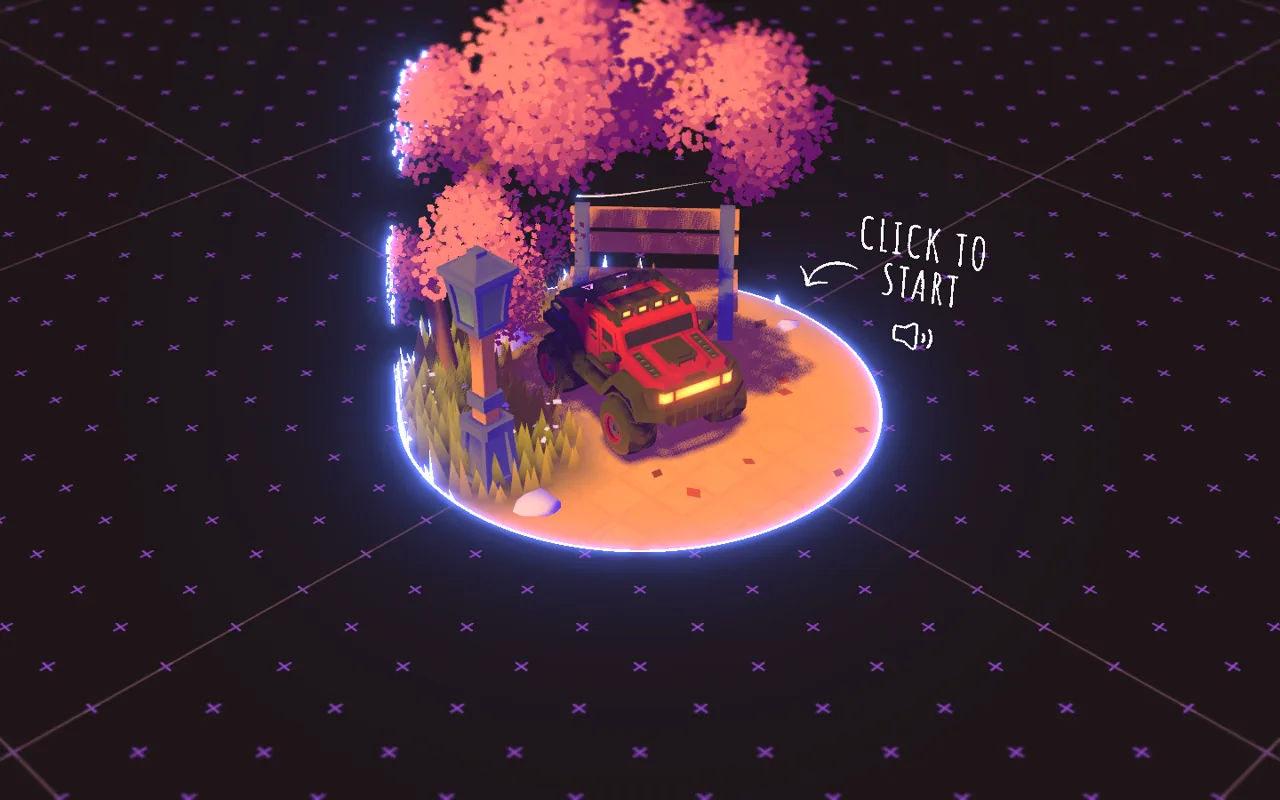
Three.js r187, released October 2026 · Renderer: WebGPU · 7.5 MB in the first 8 seconds, nothing more after 40 wheel steps (single-screen page) · About 252 WebGPU draw calls per frame · No front-end framework detected · Phone pass: 3D drawn, 7.5 MB
Bruno Simon's portfolio has been the reference Three.js site for years: you drive a little car around a world to find his work. The current version opens with the car parked on an island under a pink tree and “Click to start” scrawled beside it.
It is the only one of the twelve on WebGPU, and the newest code: Three.js r187, released on 30 October 2026, eleven days before our test. About 252 WebGPU draw calls per frame. The physics runs on Rapier compiled to WebAssembly, 1.6 MB of it, and audio adds about 2 MB. 7.5 MB in all, and the phone pass drew the full scene.
Simon also teaches Three.js Journey, a Three.js course whose site runs on WebGPU too.
Steal this: Starting a build in 2026? Start it on Three.js's WebGPU renderer. It falls back to WebGL 2 where WebGPU is missing, so older browsers still get the scene.
What 52 Three.js sites told us
Before choosing the twelve we probed 52 candidates. 32 exposed a Three.js version. The rest run something else, hide the version, or have changed since the lists were written: one now redirects to a bank.
| Three.js version | Released | Sites, of 32 |
|---|---|---|
| r126 to r150 | February 2021 to February 2023 | 7 |
| r151 to r170 | March 2023 to October 2024 | 5 |
| r171 to r180 | November 2024 to September 2025 | 9 |
| r181 to r187 | October 2025 to October 2026 | 11 |
- Most good sites are close to current. Half of the 32 run r179 or newer, and 9 run a release from the last twelve months. Three.js ships roughly once a month, so “current” moves fast.
- Old is not broken. GitHub runs r148 from December 2022, and the oldest we found was a development build of r126 from early 2021. Upgrading Three.js means working through breaking changes, so a scene that works tends to be left alone.
- WebGPU is still rare. 3 of the 32 render with WebGPU: Bruno Simon's portfolio, his Three.js Journey course and IVRESS. Every other site that drew anything used WebGL 2.
- Weight is all over the place. Across the twelve, the first eight seconds ranged from 3.2 MB to 70.0 MB. The median was 9.3 MB.
- Most skip the framework. 8 of the 12 run no front-end framework. GitHub and Shopify use React; Cartier and Primland use Nuxt.
- Phones mostly cope. 11 of the 12 drew 3D on the phone pass. Only Shopify held its scene back.
Where the megabytes go, and what the light sites do differently
Code is rarely the problem. In the heavy sites it is almost always one kind of file:
| Site | The biggest cost | Size |
|---|---|---|
| Cartier Watches and Wonders | 3D models, four of them over 4.8 MB each | 36.2 MB |
| Explore Primland | Two terrain textures, fall and summer | 20.7 MB |
| Organimo | HDR lighting maps | 13.8 MB |
| Igloo Inc | KTX2 textures, plus a music file | 11.0 MB plus 3.0 MB |
| Cartier Watches and Wonders | One animated GIF in the menu | 7.8 MB |
| Messenger | Audio, mostly the soundtrack | 3.7 MB |
Five habits separate the light sites from the heavy ones:
- They load as you go. Shopify Editions starts at 4.8 MB and reaches 24.4 MB only if you scroll all 43 screens. Oryzo sends all 16.4 MB up front, then adds nothing over 63 screens.
- They compress the 3D. KTX2 textures stay compressed on the graphics card; Draco or Meshopt shrink geometry. Shopify, Primland and Igloo ship KTX2, and Messenger ships both.
- They skip what nobody asked for. Igloo downloads 3 MB of music while the sound is off. Primland loads a second season before anyone picks it. Cartier loads a 7.8 MB GIF for a menu.
- They give phones their own cut. Primland drops from 28.2 MB to 13.0 MB on the phone pass, Messenger from 5.9 MB to 3.6 MB. Cartier drops only to 64.0 MB.
- They cap the pixels. On our 1x test screen, Cartier draws its canvas at 2160 by 1350, 2.25 times the pixels the window needs. Capping the render size is one line of Three.js.
How to check which Three.js version any website runs
Thirty seconds, no tools:
- Open the site in Chrome, Edge or Firefox.
- Open the console: Cmd+Option+J on a Mac or Ctrl+Shift+J on Windows in Chrome and Edge, Cmd+Option+K or Ctrl+Shift+K in Firefox.
- Type
__THREE__and press Enter.
A number like “187” means the site runs Three.js r187. Three.js has set that value on every page it loads since r125, released in January 2021. Match the number against the Three.js releases page to see how old it is.
Getting undefined back does not prove a site is not Three.js. Builds older than r125, custom builds and scenes running in a worker or an iframe can all hide it. Several sites we probed drew WebGL with no version showing, among them Active Theory, Dogstudio and Resn, so they either run their own engine or a build that keeps quiet.
Three.js, Spline or video: which one your site needs
| Option | Use it when | Weight to expect | Who edits it later |
|---|---|---|---|
| Three.js, custom code | People steer, explore or interact, and you need control of performance | 3.2 to 70.0 MB in our twelve; 5 to 15 MB is a sane target | A developer |
| Spline | A designer wants a 3D hero or object with simple interactions, quickly | The scene file plus Spline's own runtime | A designer, in Spline's editor |
| Video or a frame sequence | The motion is fixed and nobody needs to steer it | Video streams in; 150 stills at 100 KB is 15 MB | Anyone who can export a file |
Rule of thumb: if the visitor only watches, use video. If they steer, use real-time 3D. If a designer has to own it after launch, try Spline first, or do what Lando Norris does: keep the site on Webflow and load one custom Three.js scene into it. The longer comparison is in Spline vs Webflow vs Framer for 3D, and our older list of WebGL showcases covers sites built on other engines.
What does a Three.js website cost?
Ranges, not quotes:
| Scope | Typical agency budget | Like these |
|---|---|---|
| One live Three.js object or hero scene | $5,000 to $15,000 | GitHub's mascot, a product turntable |
| Full real-time 3D site | $20,000 to $50,000+ | Lando Norris, Explore Primland, Organimo |
| Awwwards-tier world or game | $60,000 to $150,000+ | Igloo Inc, Cartier Watches and Wonders, Messenger |
Assets sit outside every row. Models, lighting maps, scans and audio can cost as much as the code, and as the table above shows, they decide the page weight too. A build runs in four passes: storyboard, assets (modelled, scanned or splatted), scene code, then compression and a phone pass. The last pass is the one most often skipped, and the numbers above show it. Hiring one developer instead of a studio? Read what to check before you hire a Three.js developer.
DappaSol builds the first row from $3,000 on our Flagship build, usually 2 to 4 weeks. Real-time 3D sites are scoped per project. Details on the 3D and cinematic service page, and the tier-by-tier breakdown in what a 3D or scroll website costs.
Designers and agencies: send a client our way and you get 10% of the build fee, paid when the client pays. Say "referral" in the first WhatsApp message and name the client. No form, no partner portal, no minimum.
Keep going
- Websites like Igloo Inc: the 3D scroll format, taken apart
- Best WebGL websites: ten showcases and what powers them
- 3D website examples: what the good ones do and what they cost
- 3D product configurator examples: let people turn the product
- Websites like Apple: 12 product sites that scroll like apple.com
- Hire a Three.js developer: costs and what to check
- WebGL and Three.js development services, compared
- Spline vs Webflow vs Framer for 3D websites
- What a 3D or scroll website costs in 2026
- Our 3D and cinematic build service, with prices
FAQ
What are the best Three.js websites?
Our twelve for November 2026: GitHub, Shopify Editions Spring '26, Cartier Watches and Wonders, Oryzo, Organimo, Lando Norris, Explore Primland, NASA Eyes on the Solar System, Igloo Inc, Messenger, Lusion and Bruno Simon's portfolio. We confirmed each one runs Three.js by reading its version in the browser on 10 November 2026, from r148 to r187.
How can I tell if a website uses Three.js?
Open the browser console (Cmd+Option+J on a Mac or Ctrl+Shift+J on Windows in Chrome) and type __THREE__. A site on Three.js r125 or newer returns its version number, such as “187”. Getting undefined back does not rule Three.js out: older builds, custom builds and scenes running in a worker or iframe can hide it.
What famous websites use Three.js?
On 10 November 2026: GitHub's homepage (a 3D Mona mascot, r148), Shopify's Editions launch pages (r181 and r183), Cartier's Watches and Wonders site (r183), NASA's Eyes on the Solar System (r185) and Lando Norris's site (r174). Igloo Inc, Awwwards Site of the Year 2024, runs r165.
Is Three.js bad for SEO?
Not by itself. Google indexes the HTML and cannot read anything drawn inside a canvas, so keep headlines, copy and links as real HTML over or around the 3D, and make sure the first screen shows readable text before the scene loads. Canvas pixels do not count toward Largest Contentful Paint, the Core Web Vital Google scores, so a real headline or poster image should be what the first screen paints. Weight is the bigger risk: Cartier's Watches and Wonders page loaded 70 MB in our test.
Do Three.js websites work on phones?
Most do. 11 of our 12 drew 3D at phone size. Shopify Editions created a 3D context and drew nothing in nine seconds, loading 2.0 MB instead of 4.8 MB. Weight is the real issue: Cartier still moved 64 MB at phone size, while Primland served phones 13 MB instead of 28 MB.
Should I use Three.js or React Three Fiber?
Same engine either way. React Three Fiber is a React wrapper around Three.js, so the scene runs on the same renderer. Pick it if the site is already React, because the 3D becomes components. If not, plain Three.js is fewer moving parts. 8 of our 12 run no front-end framework at all.
Should a Three.js site use WebGPU or WebGL?
WebGL 2 still runs 11 of our 12. Bruno Simon's portfolio, Three.js Journey and IVRESS render with WebGPU. Three.js's WebGPU renderer falls back to WebGL 2 where WebGPU is missing, so a new build can start on it safely. On a marketing site the renderer is rarely what makes it slow; models and textures are.
How much does a Three.js website cost?
One live Three.js object or hero scene typically costs $5,000 to $15,000 at an agency, a full real-time 3D site $20,000 to $50,000 or more, and Awwwards-tier worlds start around $60,000. Models, lighting maps and audio are usually extra. DappaSol's Flagship builds start at $3,000.
Have a product, or just a question about this? You don't have to book a call. Message us. Ishan replies within 24 hours.
Something went wrong. WhatsApp us instead?
Got it. If you gave an email, a confirmation is already on its way and Ishan replies within 24 hours.