Cinematic Website Examples (2026): Ten Sites That Feel Like Film
The best cinematic website examples in 2026 range from Igloo Inc and Active Theory at the award-circuit end to founder-budget scroll-films like dappasol.com/streetsofpunk. This list walks ten sites that genuinely feel like film, what each one does differently, and what it costs to get the look, from six-figure campaign builds down to builds that start from $3,000.
TL;DR.
Which one are you? The list is the same. The next step is not.
- Building this for your own brand. Skip to what it costs, then send us the product and the deadline on WhatsApp. You get a number back the same day, not a range.
- Agency or freelancer with a client who wants this look. We build the cinematic part white-label, fixed price, on your timeline. You keep the client and the credit, terms here. Send the brief and the number comes back the same day.
- Collecting references. Good. Bookmark it, no form, no popup. The side-by-side table is the part worth saving.
Benchmarks: Igloo Inc, Active Theory, Lusion, Bruno Simon. Typography-led cinema: Locomotive, Obys. Product-scroll discipline: Apple. Founder-budget proof that the look no longer needs a six-figure invoice: Streets of Punk and Nugget Nation, both built by DappaSol from $3,000. Every example here is a live URL you can open on your phone, which is exactly the test you should apply to anyone who wants to build you one.
Reading about cinematic websites is not the same as scrolling one.
We rebuilt our own pitch as a scroll film: one continuous scroll, real client footage, no slides. The page is the demo. It takes about a minute.
Most lists of “cinematic websites” are screenshots of award sites with no explanation of why they work or what they cost. This one is different: ten live examples you can open right now, what each does differently, and the honest budget reality behind the look. Two of them are ours, and we label them as ours.
See also: Best cinematic website studios, best WebGL websites, how to hire a 3D scroll website developer, and what a 3D scroll website costs.
The ten examples
1. Igloo Inc
What it is: A studio site built as one continuous 3D world, widely cited across the design community as a benchmark for what browser rendering can feel like.
Why it works: Total commitment. There is no normal page hiding underneath; the world IS the site. Notice how loading, navigation and story all happen inside one scene.
2. Active Theory
What it is: The portfolio of the studio behind many of the biggest interactive campaign sites of the last decade.
Why it works: Restraint from people who could show off. The work does the talking and the site itself stays fast and controlled, which is its own flex.
3. Lusion
What it is: A UK studio site full of technically inventive real-time motion.
Why it works: Physics and playfulness. It proves cinematic does not have to mean slow or self-serious; the site responds to you like a game.
4. Bruno Simon’s portfolio
What it is: The famous drive-a-car-around-my-resume portfolio, still the most shared example of a personal site as a 3D world.
Why it works: It made a portfolio fun enough that people send it to friends. The lesson for a business site: memorable beats comprehensive.
5. Streets of Punk
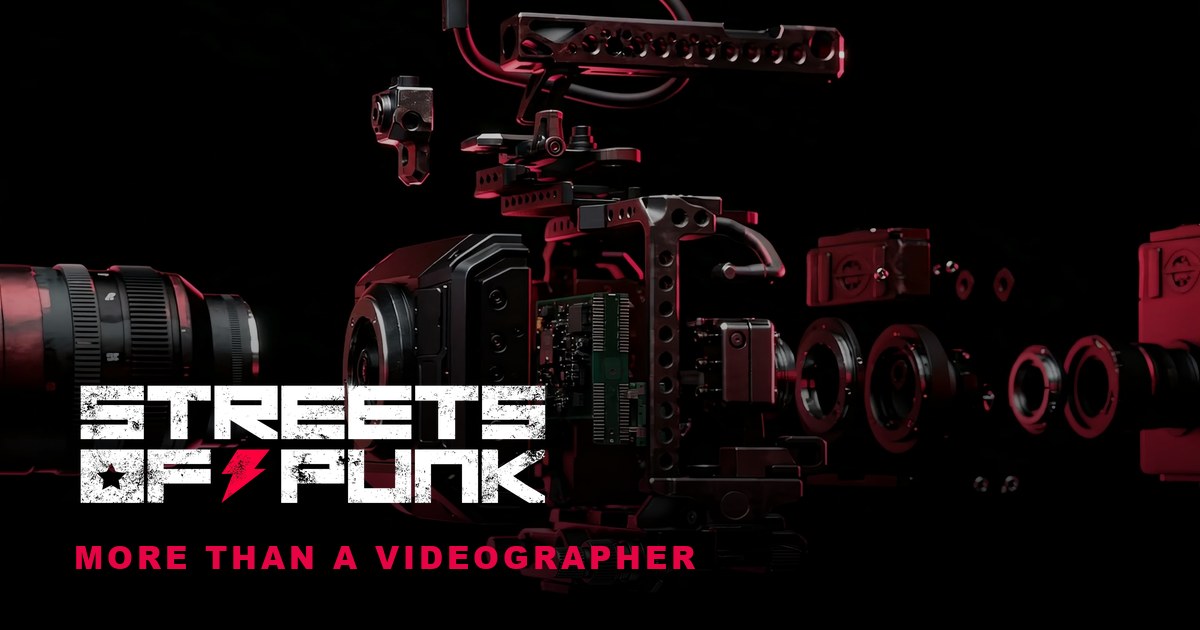
What it is: A sports videographer’s site built as one pinned scroll-film: frame sequences, kinetic type, synthesized sound, real footage graded into the film. Built by DappaSol.
Why it works: The whole page is one film you scrub with your thumb, and it holds frame rate on a phone. This is the architecture we build from $3,000, not a six-figure invoice.
6. Locomotive
What it is: The Montreal agency whose smooth-scroll library shaped how half the industry does scroll animation.
Why it works: Typography-led cinema. Barely any 3D, still unmistakably filmic, proof that pacing and type carry more than polygons.
7. Obys
What it is: A Ukrainian design agency site known for editorial, typography-driven experiments.
Why it works: Every project page feels like a title sequence. Study how they use serif type at poster scale as the visual, not decoration around the visual.
8. Nugget Nation
What it is: A QSR chicken brand site with attitude: bold motion, loud type, food photography treated like album art. Built by DappaSol.
Why it works: Cinematic does not have to mean dark and moody. A food brand with personality gets the same craft, tuned to appetite instead of awe.

9. Apple product pages
What it is: The scroll-driven product reveals Apple ships for every flagship launch, the most-copied scroll cinematography on the web.
Why it works: The gold standard of scroll pacing: every scroll position is a considered frame. Copied endlessly, rarely with the same discipline.
10. Basement Studio
What it is: A dev-focused studio whose site treats code and 3D as one aesthetic.
Why it works: It shows cinematic language selling developer tools, the proof that this style works far outside fashion and film.
Would you rather have it built than learn a tool? A Flagship 3D build starts from $3,000. Just need a sharp site fast? An Overnight Site is $399, live in 24 hours or it is free. The full service, with real builds and what they cost: 3D & cinematic sites.
Got it. If you gave an email, a confirmation is already on its way and Ishan replies within 24 hours. Or book a free 15-min call now →
How the ten compare on technique and cost
The whole list in one view. The performance column is a real number: on 16 September 2026 we ran every URL through Lighthouse 13.4.1 in headless Chrome, mobile emulation, 4x CPU slowdown, one run each. Emulated mid-range phone, not yours on 4G, so read it as a comparison between these ten. Pass means 50 or higher. The budget column is our estimate, except the two that are ours, where it is the price we charged. The two DappaSol rows were measured on the builds as we host them on dappasol.com, not on the clients’ own domains, so their scores reflect our hosting and their links open our copies.
| Site | Studio or builder | Technique | Lighthouse mobile, 4x CPU throttle | Budget band (estimate) |
|---|---|---|---|---|
| Igloo Inc | Igloo Inc, own site | One continuous WebGL world, scroll-driven | Pass, 55 | Six figures |
| Active Theory | Active Theory, own site | WebGL shell, restrained motion, video-led case cards | Fail, 43 | Six figures |
| Lusion | Lusion, own site | Real-time WebGL with physics-driven interaction | Pass, 53 | Six figures |
| Bruno Simon | Bruno Simon, solo | Three.js world you drive a car around | Fail, 30 | Personal project, paid in time |
| Streets of Punk | DappaSol, ours | One pinned canvas scrubbing a 3D frame sequence, post-process grade | Pass, 68 | From $3,000, the price we charged |
| Locomotive | Locomotive, own site | Smooth scroll and typography, almost no 3D | Pass, 71 | Six figures |
| Obys | Obys, own site | Editorial type at poster scale, scroll choreography | Pass, 57 | High five to six figures |
| Nugget Nation | DappaSol, ours | Scroll-led motion, loud type, art-directed food photography | Pass, 74 | From $3,000, the price we charged |
| Apple AirPods Pro | Apple, in-house | Scroll-scrubbed frame sequence product reveal | Pass, 64 | In-house, six figures and up |
| Basement Studio | basement.studio, own site | WebGL plus code-native motion and shader accents | Fail, 37 | High five figures and up |
What the numbers say. The three fails carry the most real-time 3D. That is a deliberate trade: a studio portfolio is judged by other studios on big screens. Your customers are not. The two top scores are ours, and the honest reason is a phone target written into the brief before anything got rendered, not that we out-engineer Active Theory.
What to look at in each one
Igloo Inc: loading and navigation happen inside the scene. Active Theory: how little the site moves, how much the work does. Lusion: interaction as physics, not hover states. Bruno Simon: memorable beats comprehensive. Streets of Punk: scrub slowly and you see the frame sequence itself. Locomotive: count the 3D elements, there are almost none. Obys: serif type as the visual. Nugget Nation: the same craft aimed at appetite. Apple: stop anywhere, it still works as a frame. Basement Studio: cinematic language selling dev tools.
What every example on this list shares
Strip away the different styles and the same four decisions repeat. One visual idea, committed to completely. Motion driven by the visitor’s scroll, never autoplaying at them. Real text that search engines and screen readers can read, no matter how much WebGL is behind it. And a performance budget: every site here runs on a phone, because a cinematic site that melts phones is just an expensive way to lose visitors.
Getting the look without the campaign budget
The award-circuit examples above are six-figure productions, and for a global launch that is the right tool. For a founder or a growing brand, the same architecture, one pinned canvas, scroll-scrubbed frames, a post-process grade, is what DappaSol ships as a Flagship build from $3,000, in weeks. Streets of Punk and Nugget Nation above are the live proof. If you want something sharp today rather than cinematic this month, a fast business website is $399, live in 24 hours or it is free. And if what you actually need is your own work presented this well, that has its own lane: a done-for-you portfolio website, $399 live in a day, film-grade from $3,000.
The ladder in plain numbers: $399 for an Overnight Site if you need sharp and fast, not filmic, from $3,000 for a Flagship scroll-film build. What moves you up that ladder is scope: how many scenes, how much gets modelled, shot and graded. The line-by-line version is on what a cinematic website costs.
The cinematic work is the visible half of what we do. The other half looks like Henny Bot, a Telegram trading bot we built. Not a cinematic site, and that is the point: the same people handle the plumbing under the film.
If you run an agency or freelance and a client wants this look: we build the scroll-film part white-label, fixed price, on your timeline, and you keep the client and the credit. The full partner terms, white-label and referral, are on the agencies page. Send the brief on WhatsApp and you get a number back the same day.
If you want the mechanics rather than the gallery: what cinematic web design actually is, what a cinematic website costs, and how to make one yourself. Hiring rather than building? Start with how to hire someone to build a website.
Designers and agencies: send a client our way and you get 10% of the build fee, paid when the client pays. Say "referral" in the first WhatsApp message and name the client. No form, no partner portal, no minimum. Full terms on the agencies page.
Keep going
- Immersive website examples: ten sites that pull you in
- Scroll animation website design: how the effect actually works
- What a scroll-driven 3D website is, and when you want one
- Film website examples: production companies and DP portfolios that sell the work
- Interactive website examples: ten sites that talk back
- Our 3D and cinematic build service, with prices
- Scrollytelling website examples: ten sites worth the scroll
- Luxury website design examples: ten high end sites worth the money
- Horizontal scrolling website examples that earn the sideways scroll
- Storytelling website examples: how brands sequence the story
- 3D website examples: what the good ones do and what they cost
- Best WebGL websites: ten showcases and what powers them
FAQ
What makes a website cinematic?
Three things, working together: one continuous visual world instead of stacked sections, motion that is driven by your scroll so you control the pacing like scrubbing a film, and a deliberate grade, lighting, grain and typography that feel art-directed rather than templated. The tech underneath is usually WebGL or Three.js with scroll-driven animation, but the tech is not the point. Plenty of Three.js sites feel like tech demos. The cinematic ones feel like someone directed them.
How much does a cinematic website cost?
The famous examples from studios like Active Theory sit in six-figure campaign budgets. DappaSol builds cinematic scroll-film sites from $3,000, senior-led, which is the founder-budget end of real custom work. Template-based approximations cost less but read as approximations.
Do cinematic websites hurt SEO or performance?
Only when they are built badly. The common failure is shipping a desktop demo that melts phones and hides all its text inside a canvas where search engines cannot read it. Done right, the film runs on the GPU, the text stays real HTML, the page holds frame rate on a mid-range phone, and search engines read a fast, structured page. Ask any builder to show you their example running on your own phone.
Are cinematic websites just for big brands?
No, and that is recent. The look used to require an award-circuit studio budget. The tooling matured, and a senior engineer can now ship a scroll-film site in weeks. That is why you now see restaurants, personal brands and small product companies with sites that feel like film, not just sneaker launches.
Which tools do cinematic websites use?
Most of the sites on this list use Three.js or raw WebGL for rendering, GSAP ScrollTrigger for scroll choreography, and frame-sequence or shader techniques for the film feel. Some lighter examples use Spline embeds or video scrubbing. The stack matters less than the direction: the best examples commit to one visual idea and execute it all the way through.
Reading about sites like these is not the same as having one. Tell us what yours has to do and you get a real number back, not a range. A flagship scroll build starts from $3,000. If you just need something sharp and fast, an Overnight Site is $399 and it is live in 24 hours.
Got it. If you gave an email, a confirmation is already on its way and Ishan replies within 24 hours. Prefer to talk now? WhatsApp us →