Shopify Website Cost in 2026: Build, Expert, and Monthly
What you are building, not who you hire, decides the number. Fix the scope, then compare totals. A paid-theme setup runs $500 to $2,000, a store built to convert $2,000 to $4,000, a migration or app-heavy build $2,000 to $10,000, a full-service agency build $10,000 to $50,000 and up. Shopify and its apps add $150 to $500 a month.
TL;DR
- Hiring cost is priced by job, not by person. A theme tweak is low hundreds. A store built to convert is $2,000 to $4,000. A migration is $2,000 to $10,000.
- Shopify's own bill is separate and permanent: roughly $39 to $105 a month on core plans, plus about 2.9% and 30 cents per order, plus apps.
- Apps are the line that quietly doubles the monthly. Budget $150 to $500 a month before you spend a cent on marketing.
- A full store launch, including inventory and traffic, realistically runs $5,000 to $9,000. The store is the cheapest part of the store.
- Anyone who quotes your store before seeing your product count and app list is guessing, and you pay for the guess in change requests.
Two different questions hide inside “Shopify website cost”, and mixing them up is how budgets go wrong. One is what you pay a person to build the thing. The other is what you pay Shopify, forever, whether the store sells anything or not.
Here are both, with real bands. We build Shopify stores for a living, so read the bias accordingly and check the numbers against three other quotes.
The short version: $500 to $2,000 on a paid theme, $2,000 to $4,000 for a store built to convert, $2,000 to $10,000 for a migration or an app-heavy build. Then $150 to $500 a month to Shopify and its app ecosystem before you spend anything on marketing.
How much does a Shopify expert cost?
Price the job, not the person. The same developer is cheap for one task and expensive for another, and “what does a Shopify expert cost” has no answer until you say what you want built.
| What you are actually buying | Realistic range | Sensible hire |
|---|---|---|
| One theme tweak or bug fix, clear spec | Low hundreds | Freelancer |
| Basic store setup on a paid theme | $500 to $2,000 | Freelancer or senior-led studio |
| A store built to convert: custom sections, real product pages | $2,000 to $4,000 | Founder-direct senior studio |
| Migration from WooCommerce, Wix, Magento (data plus redirects) | $2,000 to $10,000 | Whoever mentions redirects first |
| App-heavy build: subscriptions, B2B pricing, custom logic | $2,000 to $10,000+ | Specialist agency |
| Custom design system, headless, Plus-tier work | $10,000 to $50,000+ | Full-service agency |
Two rules save most of the money. A theme tweak is a gig, so pay gig rates and stop researching. A store you run revenue through is infrastructure, so the cheapest bid is usually the most expensive outcome. People get this backwards in both directions, and the second one costs more.
What about hourly rates?
You will be quoted them. Marketplace freelancers sit at the bottom, senior independents and small studios in the middle, agencies at the top, and the gap is mostly project management and bench cost rather than skill.
Ignore the rate. An hourly figure tells you nothing about how many hours the job takes, and the cheapest rate on a job that takes four times as long is not a saving. Ask for a fixed price after they have seen your product count and your app list. Compare totals.
Why nobody can quote you in the first email
A store price depends on four things a stranger cannot see: how many products and variants, what you are migrating from and how many live URLs exist, which apps you need, and who edits the store after launch. A number offered before those answers is a guess with your money attached, and the correction arrives later as a change request.
The full hiring process, including the four questions that filter out the wrong person, is in how to hire a Shopify expert. If you want the shortlist instead, we ranked the best Shopify experts for small business, our own shop included, with printed criteria you can use to discount us.
What Shopify itself costs every month
This is the bill nobody building your store includes, because it is not their invoice.
| Line | Typical 2026 range | Notes |
|---|---|---|
| Shopify core plans | ~$39 to $105 a month | Enterprise tier sits far above this. Check the current pricing page |
| Payment processing | ~2.9% + 30 cents per order | Varies by plan, country and whether you use Shopify Payments |
| Apps | $30 to $100+ a month | The line that quietly doubles the monthly |
| Email and marketing tools | $0 to $50 a month | Free until your list grows, then not |
| Paid theme (optional) | One-off, low-to-mid hundreds | Free themes are genuinely fine to start |
| Realistic monthly, pre-marketing | $150 to $500 | Before a single dollar of traffic |
Those figures move. Shopify publishes its plans and changes them, processing rates differ by country and plan, and app pricing is whatever the app developer decides this quarter. Treat the table as a sense of scale, then verify the two lines that matter to you before you commit.
The apps line is the one that surprises people. Every store starts with three apps and ends with nine, and each one is $15 a month that felt reasonable on the day.
The whole launch budget, not just the website
If you are starting from zero, the build is one line of five.
Not sure your numbers work yet? Our online store planning prompt makes ChatGPT interview you about margins, shipping and platform choice before you spend anything.
| Line item | Realistic cost | What gets left out of the cheap guides |
|---|---|---|
| Platform, domain, email (year 1) | $500 to $1,000 | Apps and transaction fees stack on top of the headline plan price |
| Storefront build | $2,000 to $4,000 founder-direct | Templates convert like templates |
| Product photography | $300 to $1,500 | Online, the photos are the product. Phone shots cap your price |
| First inventory | $2,000 to $4,000 | Dropshipping moves this cost into ads and refunds |
| Launch marketing | $1,000 to $2,000 | Left out entirely, and it is the line that decides the outcome |
| Total | $5,000 to $9,000 | The gap between a store existing and a store selling |
The full version of that arithmetic, including the two mistakes that kill first stores, is in what an online store really costs.
The store is the cheapest part of the store. Budget for the business, not the subscription.
Where the money actually goes wrong
Not the platform fee. Four other places.
The migration nobody priced properly. Products, variants, customers, orders, and every live URL mapped to its new home. Skip the redirects and you keep the traffic for about a fortnight, then it goes. That is the single most expensive corner anyone cuts on a Shopify build.
Lock-in you did not notice buying. If day-two edits need their page-builder licence, their app or their team, you rented a store. Ask who owns the theme code before you sign, not after. Who owns your website covers what to check.
Paying store prices for a website. Plenty of businesses pay a platform fee forever for inventory, shipping and tax machinery they never touch. If under five products and no stock is your situation, read do I need Shopify or just a website before you spend anything.
Buying the build and forgetting the traffic. A store with no traffic budget is a brochure in a drawer. “We will do organic” is a nine-month plan wearing a nine-day costume.
What we charge, and when not to hire us
We build Shopify e-commerce storefronts from $1,500, fixed price, quoted after we have looked at your catalog and your app list. You own the theme code and the account. No page-builder lock-in, no per-change dependency on us. If you only need a normal website rather than a store, that starts at $399.
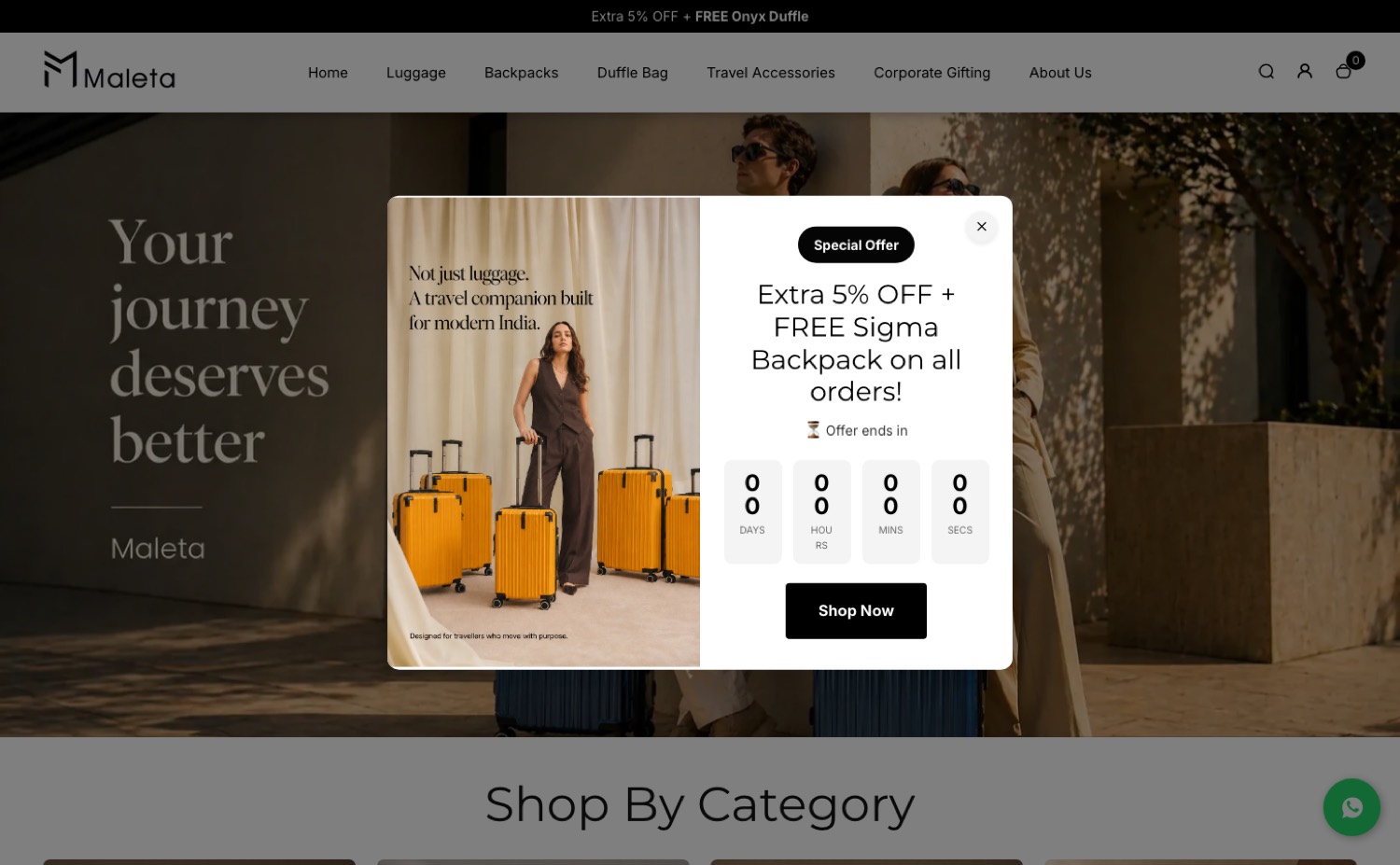
You can go and judge the work: themaleta.com is live, so open it on your phone and try to buy something. Nugget Nation and BigSmall are Shopify too.
Our Clutch profile carries one verified review, published 5 August 2026 by Martin Naithani, Co-Founder of Innovation Theory in Denver:
“They worked super fast and delivered quality code, which was appreciated and hard to find in the service industry.”
Read that honestly. It was not a Shopify build, it was an MVP, and we quote it because it is the review that is public and verified, not because it proves anything about storefronts. For the Shopify judgement, use the live store.
When not to hire us: if you need a forty-person bench running five workstreams at once, we are one senior studio and an agency is the right call. If you need one theme tweak, a good freelancer will do it cheaper than we will, and that is the honest answer.
What to read next
Still choosing a platform, Shopify vs WooCommerce for small business settles it on maintenance cost rather than feature lists. Ready to hire, how to hire a Shopify expert has the brief, the four questions and the contract terms.
Or tell us what you are building and we will give you a number, or tell you that you do not need us yet. We have talked people out of a build before. It is cheaper than talking them into the wrong one.
Not sure whether you need a developer at all? Shopify theme or developer puts the four routes, their cost and what breaks at a theme update in one table.
FAQ
How much does a Shopify expert cost?
Price the job, not the person. A single theme tweak or bug fix with a clear spec costs in the low hundreds. A basic store setup on a paid theme runs $500 to $2,000. A store built to convert, with custom sections and real product pages, runs $2,000 to $4,000. Migrations and app-heavy builds run $2,000 to $10,000 and up, and custom design systems, headless or Plus-tier work run $10,000 to $50,000 and up. DappaSol builds a Storefront from $1,500, fixed price, code owned by you.
How much does it cost to hire a Shopify expert per hour?
Hourly bands vary by tier and region, and they move. Marketplace freelancers typically sit at the low end, senior independents and small studios in the middle, and agencies at the top because you are also paying for project management and a bench. The band matters less than you think: an hourly rate tells you nothing about how many hours the job takes. Ask for a fixed price after they have seen your catalog, and compare total numbers, not rates.
How much does a Shopify website cost to build?
$500 to $2,000 for a clean setup on a paid theme, $2,000 to $4,000 for a store engineered to convert, and $10,000 to $50,000 and up for a custom design system or a headless build. The spread is real, because 'Shopify website' covers everything from a five-product side project to a catalog with variants, subscriptions and B2B pricing.
How much does Shopify cost per month?
Shopify's core plans run roughly $39 to $105 a month, with the enterprise tier far above that, and prices change so check Shopify's pricing page before you budget. On top of that: payment processing at roughly 2.9% plus 30 cents per order, and apps. Apps are the surprise. Budget $150 to $500 a month for a small store before marketing.
Why are cheap Shopify experts risky?
For a tweak, cheap is fine, and we would rather say that than sell you a build. For the store your revenue runs through, the cheapest bid usually costs the most twice. The things that get skipped at the bottom of the market are the invisible ones: URL redirects on a migration, checkout and tax config, mobile speed, and handover. You do not find out until the traffic drops.
How much does it cost to start an online store, all in?
$5,000 to $9,000 for a one-product brand done properly: $500 to $1,000 in platform and setup for year one, $2,000 to $4,000 for the storefront, $2,000 to $4,000 in first inventory, and $1,000 to $2,000 for launch marketing. A DIY template store can go live for under $1,000. An agency build runs $10,000 to $50,000. The marketing line is the one the cheap guides delete.
How much does a Shopify migration cost?
$2,000 to $10,000 depending on product count, variants, and how messy the old data is. The price is in the data and the redirects, not the design. If a quote for a migration does not mention URL redirects in the first conversation, that quote is missing the part that protects your search rankings, and no discount makes up for losing those.
Do I need to pay for a Shopify theme?
No. Shopify's free themes are competent and genuinely fine for testing demand. Paid themes in the official Theme Store are a one-off purchase, commonly in the low-to-mid hundreds, and check the current price on the listing because they change. A paid theme buys you sections and layouts, not conversion. What you do with it matters more than which one you bought.
What is not included in a Shopify build quote?
Usually four things: your Shopify subscription, app subscriptions, product photography, and traffic. Photography runs $300 to $1,500 and it is not optional, because online the photos are the product. Traffic is the big one. Whatever the build costs, hold roughly that much again for launch marketing or you have built a shop on a street with nobody on it.
Is a fixed price better than hourly for a Shopify build?
For a defined store, yes. A fixed price means someone read your brief and took the risk of estimating it, which is exactly the work you want done before the build, not during. Hourly suits open-ended discovery and ongoing tweaks. The bad version is an hourly rate on a job that was always a fixed scope, because then the meter runs on their learning curve.
Does a US-based Shopify expert cost more?
Yes, usually a lot more, and some of that premium is real: same-day meetings, a local contract, someone in your legal system. What it does not buy you is a different Shopify, because the platform and the theme code are identical everywhere. Decide whether you are buying skill or buying a timezone. Both are legitimate. Just do not pay for one and think you got the other.
A store that looks right and still does not sell is a conversion problem, not a theme problem. We build custom Shopify and D2C storefronts from $1,500: product setup, checkout, trust design, and the speed work that stops people leaving before the page paints.
Got it. If you gave an email, a confirmation is already on its way and Ishan replies within 24 hours. Prefer to talk now? WhatsApp us →